

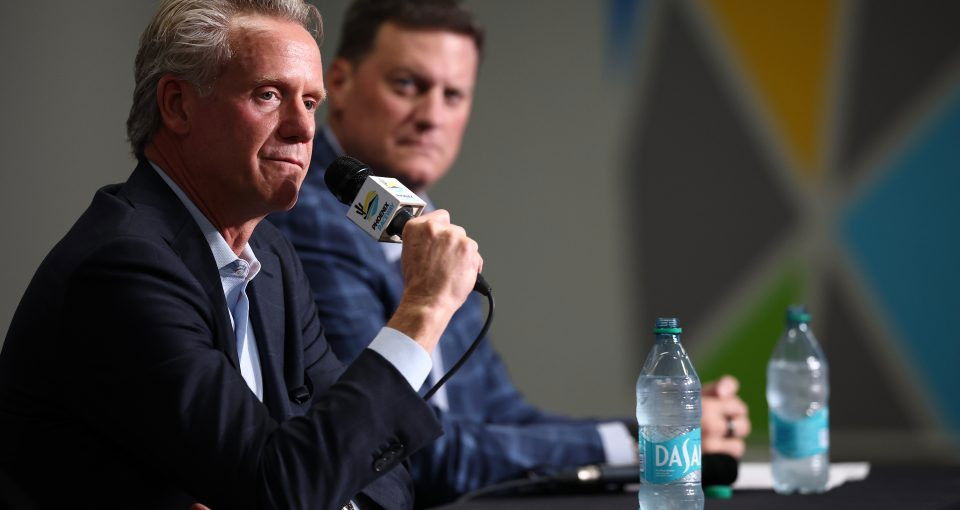
Under a Halloween morning sun at Phoenix Raceway, NASCAR commissioner Steve Phelps and president Steve O’Donnell offered a clear message: the sport is moving, growing and willing to shake up its biggest traditions if that’s what it takes to keep momentum.
“Momentum” was Phelps’ word of the day, and he used it often.
He thanked fans, teams, tracks and partners, then pointed to signs the industry hasn’t seen in years. More sponsors on cars, healthier track deals and a commercial ecosystem that’s finally humming again.
The latest proof came with Freeway Insurance joining Coca-Cola, Busch Light and Xfinity as a fourth Premier Partner. “Sponsorship is back,” Phelps said, calling the current level the strongest in roughly 15 years.
The growth isn’t just measured in decals. NASCAR’s Driver Ambassador Program, born out of the Driver Advisory Council, logged 6,000 hours of appearances this year, a 40% jump that puts drivers on morning shows, late-night sets and even Sesame Street. Pair that with NASCAR’s push onto Fortnite, Roblox and a steady diet of serialized storytelling. Netflix projects, an Earnhardt doc, and a new YouTube series titled RISING, and you get a portrait of a league that’s trying to meet fans wherever they live.
And yes, the destination for the sport’s biggest weekend is changing addresses. After six straight years, Phoenix will hand off the championship to Miami next season as part of a new rotation model.
Secure your spot today.
Phelps praised Latasha Causey and the Phoenix market and made it clear this isn’t goodbye forever, but said a rotating finale was a consistent ask from the industry.
Miami gets the call in 2026.
O’Donnell handled the competition side and struck an upbeat tone.
Collaboration is better than it has been “in years,” he said, citing closer feedback loops among teams, OEMs and NASCAR’s competition group.
He singled out Goodyear, a frequent target in the early Next Gen days, for delivering the tire wear drivers had begged for without tipping into chaos. “It’s putting it back in the drivers’ hands,” O’Donnell said.
The horsepower discussion is alive, especially for short tracks. NASCAR will test this offseason at North Wilkesboro with more power, tire work and potential aero tweaks.
Nothing to announce yet, O’Donnell cautioned, but the direction of travel is obvious: more driver control, less aero dependency.
That philosophy aligns with an eclectic 2026 schedule vision.
O’Donnell touted the Navy’s 250th-anniversary race on a U.S. naval base, already the biggest presale in NASCAR history and drawing seventy percent new fans, while emphasizing the sport won’t abandon its roots.
North Wilkesboro gets a points race, and Speedway Motorsports’ is move to send the All-Star Race to Dover Motor Speedway is already paying off in ticket sales. Phelps said the All-Star race at Dover will be “fun” and that they will be trying “new things.”
The media picture is more complicated, but Phelps didn’t flinch.
Year One of the seven-year rights deal brought a distribution reshuffle toward cable and streaming, and NASCAR told partners to expect a step back before growth. Cup ratings are down 14 percent “exactly what we projected,” Phelps said, while Xfinity overperformed expectations with a younger audience on Amazon.
The short-term pain, he argued, comes with a long-term upside once fans learn the new viewing habits.
The plan going forward, he added, is to keep the Daytona 500 clear of the Super Bowl, even if that means a later date becomes permanent.
If there was a pivot point in the address, it came when Phelps read a prepared statement about the ongoing lawsuit filed by two teams.
NASCAR rarely cracks the door on finances, but with court records unsealed, Phelps leaned into specifics. He framed the 2025 charter agreement as a meaningful upgrade on the 2016 model—more than $3 billion in guaranteed payments to teams, 14 years of charter security through at least 2039, and an estimated $1.5 billion in enterprise value across the grid.
He said NASCAR’s balance sheet includes over $1.2 billion in invested capital and reiterated the league pours “the vast majority” back into the sport people, tracks, the racing product.
“This is not an antitrust case,” Phelps said, adding the charter system was created “with and for the teams” and is worth defending. He acknowledged the bitterness of private comments becoming public and asked the room to resist trying to litigate details with follow-ups.
The message was less legalistic than philosophical: NASCAR believes the model is fair, sustainable and aligned with long-term fan value.
There were more practical notes. The league has debt service from the ISC merger, Phelps said, and must maintain reserves for the unpredictable realities of running a sanctioning body with national tracks and multiple series.
Teams, he added, receive roughly $1.1 billion annually when you combine sponsor revenue and NASCAR distributions.
Costs for car materials are down about 40 percent since the Next Gen rollout, and the Driver Ambassador Program is part of a three-pronged strategy to grow the pie.
O’Donnell also confronted a new version of an old problem: how to keep the heavyweights from running away with it as technology becomes the competitive currency.
Big teams with deep simulation departments and AI resources have an edge. NASCAR wants to give engineers and crew chiefs more room to find speed. The ingenuity fans romanticize about it, and without reopening a spending arms race.
That’s the needle to thread with future rules.
On powertrains, the hybrid drumbeat is softer than it was a few years ago.
O’Donnell said the timeline has “slowed,” not because of politics but because NASCAR is taking a methodical approach with OEMs while also learning from IMSA. ABB’s work on electrification demos has been instructive, and hydrogen is part of the broader conversation.
The priority is to make a long-term choice that maps to what manufacturers need to sell cars, not to chase a trend and get boxed in.
One place the future is much clearer is OEM expansion. Ram is officially returning to the Truck Series in 2026, and Phelps said conversations with additional manufacturers are ongoing at varying levels of seriousness.
He didn’t promise anything, but he didn’t hide his enthusiasm either.
“We’re thrilled,” he said of Ram, hinting the door to Xfinity—soon to carry O’Reilly Auto Parts title branding—could open next.
Other housekeeping landed with quick, confident answers.
When asked if fans would trust an officiating call against Denny Hamlin in the title race amid a legal dispute, O’Donnell bristled: “That’s an absurd question.”
O’Donnell praised the transparency and performance of an officiating group that’s kept the hauler quiet all year.
NASCAR also confirmed Tim Bermann is calling Cup races after Jusan Hamilton’s untimely departure, which the league labeled an internal matter.
By the time the session wrapped, the through-line was unmistakable.
NASCAR plans to keep pushing with rotating championships, audacious one-offs like a naval base race, a points weekend at North Wilkesboro, and a steady stream of content designed to turn drivers into household names.
They will tweak horsepower and aero as needed. They will live with a short-term ratings dip in exchange for a more modern distribution footprint, and they will defend their business model in court while insisting the charter era is good for everyone who shows up on Sundays.
“We have challenges, sure,” Phelps said. “But what we do better than any other sport is band together and solve them.”
O’Donnell nodded to the grind—28 straight Cup weekends at one point this season—and thanked teams, OEMs and NASCAR staff for powering through the noise.
The sport’s leaders believe the product on track is the best it’s been in years, and they’re betting big that the rest will follow.
The next few nights will still end with champions being crowned, but the bigger story here is a league trying to prove it can be both restless and rooted. A traveling circus that experiments without losing itself.
If NASCAR can thread that needle, Miami won’t be the only thing rotating in next year’s headlines.
The narrative will, too.


















Discussion about this post